
220 Years of W.J. French & Son
1803 – 2023
The History of W.J. French & Son by Caroline French
This year our business is 220 years old. We are one of the oldest independent shoe shops in country that has been passed down directly through the family and I believe the oldest independent retailer in Southampton.
Here is a brief canter through the family tree to show you how we have evolved.
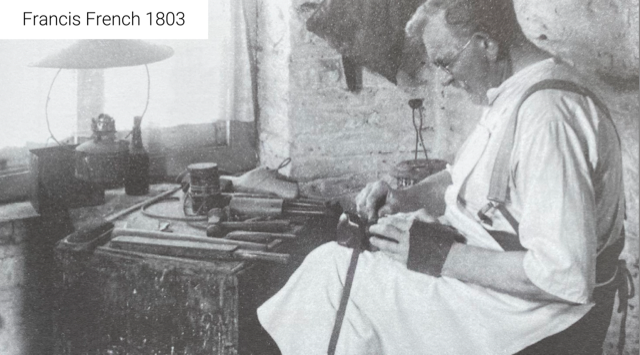
Francis French
Our history is based upon the experiments and very hard labours of our ancestors. Francis French was born in 1779, became an apprentice shoemaker in 1794 and was married to Martha on Christmas Day in Eling Church in the year 1802, It was he who opened the first of our shoe shops in the following year, when he became a master shoemaker.
Shoe making was a local craft rather than an industry and the majority of work was done by outworkers in their own homes. Eldest sons learnt their father’s trade from an early age helping Dad, use pincers, hammers, awls and tacks to produce complete shoes.
William French (2nd Generation) 1830s
The arrangement would certainly be that Martha and her family would make the uppers for the shoes whilst Francis would do the rest of the work. Certainly, they were not short of helpers, because by 1827 they had a family of 8 children – the first son William (2nd generation) took over his father’s business at the age of 24 and sold shoes from his shop in Hanover Buildings near Above Bar Street and in 1848 Manchester Street, where the Marlands shopping centre is today.
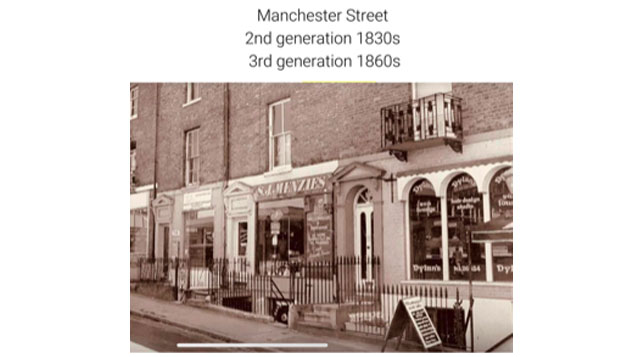
William French (3rd Generation) 1860s
We moved our shop in Southampton many times, but when we got to Manchester Street we seemed to have stayed there over 50 years and we have been in our present premises in Bedford Place since 1890 (133 years).
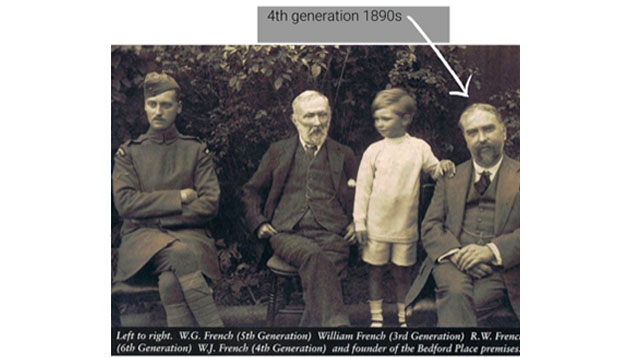
William James French (4th Generation) 1890s
Almost every generation of French’s have been responsible for a great step forward in our business methods, bringing the business more up to date.
In 1890, shoes started to be mass produced in factories and it was W. J. French who realised that these modern ready-made shoes had a future and opened our shop in Bedford Place. His father was hesitant about this move and maintained that most customers do not have a pair of feet the same size, so that a ready-made shoe could not possibly fit.
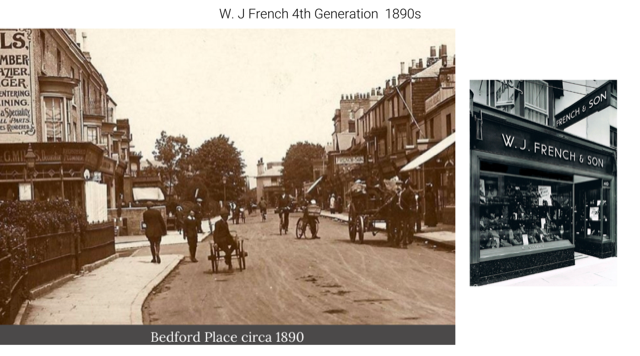
W.J. French found that this was true, and spent a great deal of his life perfecting methods of adapting ready-made Victorian boots, to give the same comfort and fit as the bespoke shoe, which was one of the most highly prized assets of our business, with four men in the Workshop spending a fair part of their time in between making and repairing shoes, in modifying shoes until they exactly matched the odd foot.
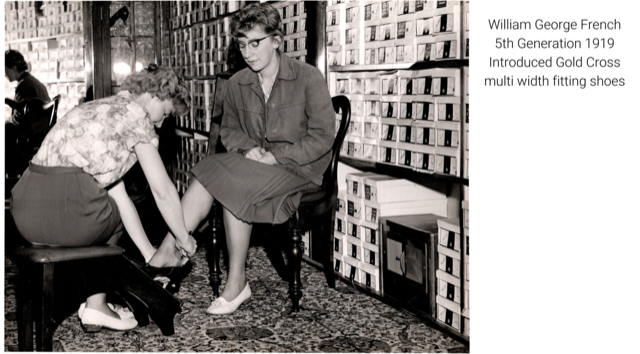
William George (5th generation) 1919
After the first world war, the old barriers of the Victorian class system were breaking down shifting the way people saw themselves and therefore the way they dressed. Women of differing social classes were now influenced by the same trends and were wanting the same looks, with the only difference being, they were able to afford different qualities.
It was William George who just after the first world war, was a pioneer in bringing in multi-fitting shoes, that is shoes made in a such a variety of fittings that almost every foot could be accurately fitted. This meant vast stocks when you consider that then, as now, we often carry between 4 to 6 fittings to every half size, which helped continue our reputation for fitting quality shoes.

The Pedoscope was a great bit of technology that allowed you to see the bones of your feet and the outline of the shoe.
However, a growing awareness of radiation hazards meant they were gradually phased out.
Ronnie French (6th Generation)
Ronnie French started in the business when he was 16 in 1927. During the second world war he worked in the fire service, whilst his parents worked and lived at the shoe shop until they retired in 1945.
Our shop was open throughout the war, but the workshop had to close as the men one by one went to war. Shoes became harder and harder to buy as shoe factories were making torpedo parts, or airmen’s shoes and boots for the American and British army.
The shop walls were covered with boxes as they still are today, but were mostly empty. Shoes were so scarce that William George decided he would only sell shoes to customers he liked!
After the war Ronnie was now the only person employed at the shop. This is a quote I found from his notes: “When I came back to business after the war I had no staff whatsoever, and it was a red letter day when our first employee joined us – a very solemn girl of 14- and our first job after we had cleaned the shop front, was to count our stock, which on that day was seven pairs of shoes.”
Desperate to get hold of some stock he called up one of his favourite footwear suppliers at the time – K shoes in Kendal and asked them what he should do if he wanted to get hold of some stock.
The factory manager told him, that shoes were so scare he would basically have to camp out at a shoe factory until they agreed to give him some. The next day Ronnie drove to Kendal in Cumbria and waited at the factory until he was given enough shoes to fill his car, before returning home. From our records it is noted that in 1946 we had 223 shoes in stock.
The evacuation of thousands of children to the countryside dramatically increased the demand for sandals and the government instructed Start-rite to make better quality shoes for children post war. Children’s foot gauges were introduced along with a range of width fittings, we invested heavily in buying and selling children’s shoes which made our children’s department much stronger and which we are still well known for today.
By the mid-1950s, the UK economy had fully recovered from the damage caused by the war, and there was a significant increase in production and economic growth. During the 60s business was good. Ronnie wanted to open another shop and looked at Salisbury and other local areas.
However, Ronnie’s wife pointed out that it might be wiser to extend our current shop in Bedford Place, so Ronnie could continue to work on the shop floor, which he loved to do, and not get caught up with administration of running multiple sites. So by purchasing the butchers shop to the north and the wool shop to the south, extending the lower ground floors and building upwards, he now had three shops in one over 5 floors.
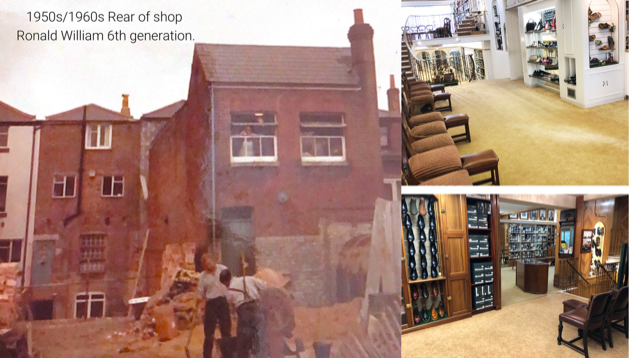
It was during this time that we employed 40 members of staff including 3 shoemakers. My grandfather made sure that fitting techniques were rigidly controlled, and fitters were not allowed to fit independently until they had been in the job for 7 years! This is how seriously he took the fitting size of the business.
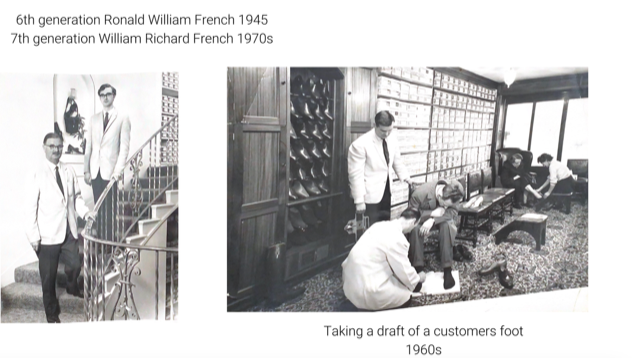
Richard French (7th Generation) Richard French started working at the shop in 1963 when he was 16. He was trained in the company’s workshop and also at various shoe factories including the Clarks factory at Street, Barkers in Northampton and spent a year on the shop floor at Harrods before returning to Southampton.
During the 70s and 80s many traditional shoe factories were moving from the UK to India and China for cheap labour which had far-reaching effects on the retail industry. It led to changes in pricing, competition, supply chains, and consumer perceptions, shaping the way footwear is produced, marketed, and sold today. We were able to stock a wider range of styles and brands but always focused on quality.
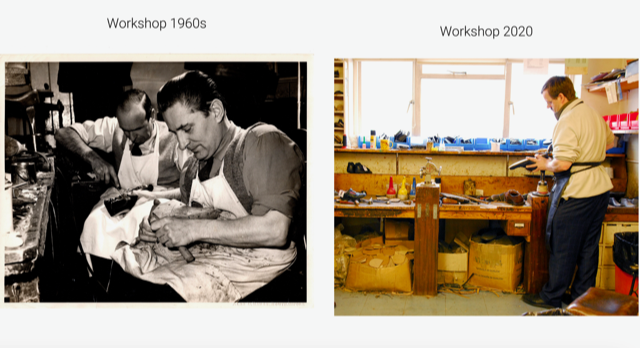
We stopped making shoes in 1980s as the shoes from factories were getting so much better and the cost to make a shoe by hand was getting more expensive. Although we still repair shoes in our onside workshop today.
The recessions of the 70s, 80s and 90s created further challenges. The 1973 oil crisis led to a significant increase in the cost of energy and contributed to inflationary pressures which resulted in us having to reduce staffing levels.
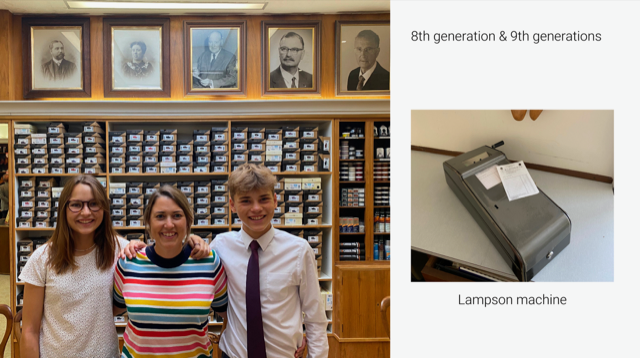
Caroline French (8th Generation) I took over the business in 2014 and introduced technology! Instead of handwriting receipts on the Lampson machines and the lady in the booth that sat with the till all day, we now have two EPOS tills that integrate with our e-commerce website which monitors the stock we hold.
My children work in the shop during the holidays, but they don’t know whether they want to live the shoe dream just yet.
I think there is still a place for shops like French’s, where people see we give value and are good at what we do. We offer quality products, value for money and a genuinely helpful, knowledgeable service which saves time for our customers and makes sure they get the right pair of shoes. We are still able to offer a customer experience which can’t be found by shopping online.
Comments are closed here.